Solo show
Exhale/Inhale – kaufmann repetto (2025-2026)Inhale/Exhale – kaufmann repetto (2025-2026)
Temple of Love. Cœur – Scuola Piccola Zattere (2025)
L’Ère du Verseau – Marcel Duchamp Prize, Centre Pompidou (2024-2025)
Temple of Love – To Hide, KfW Stiftung (2024)
Maât and the tears of God – Aware Prize (2024)
Lorna Simpson & Gaëlle Choisne – Mentorship, Reiffers Art Initiatives (2023)
Immortelles – A SUD (2023)
Blue Lights in the Basement, Nicoletti Contemporary (2022)
Temple of Love — To Hide, Kunstlerhaus Bethanien (2022)
Temple of Love — Atopos, MAC VAL (2022)
Mondes Subtiles, Air de Paris (2021)
Défixion, Musée Henri-Prades and MO.CO, Panacée (2020)
Hybris, galerie Untilthen (2018)
The Sea Says Nothing, openstudio Rijksakademie (2018)
Openstudio, Rijksakademie (2017)
C R I C C R A C, Centrale Gallery Powerhouse (2015)
Cric Crac (2015)
Group show
Reinventing Photography – Hangar (2026)Copysts – Centre Pompidou-Metz (2025-2026)
Magical Realism: Imagining Natural Dis/order – WIELS (2025)
FEMMES, Perrotin Gallery (2025)
The Last Place They Thought of, Kunsthal Mechelen (2024-2025)
Siren Songs, Villa Medici (2024-2025)
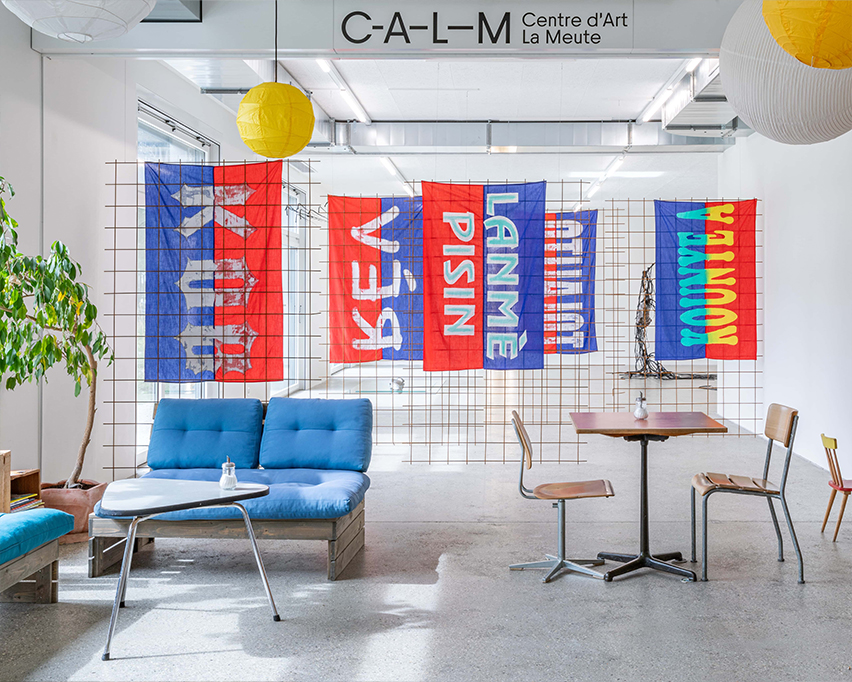
This is the time of sweet sweet change for us all, C-A-L-M Centre d’art la Meute (2024)
Van Gogh and the Stars, Fondation Van Gogh (2024)
Ritual in transfigured time – NW, Aalst (2024)
Temple of Love — Love To Love, New Museum (2021-2022)
Les moyens du bord, La Villette x Centre Pompidou (2020)
Le fil d’alerte, Fondation Ricard Prize (2019)
Culture Pop Marauders, Mains d’Oeuvres (2016)
Potomitan, Tour Panorama (2014)
Temple of Love
Temple of Love. Cœur – Scuola Piccola Zattere (2025)Temple of Love – Tutti Sistemati, Toronto Biennial (2024)
Temple of Love – To Hide, KfW Stiftung (2024)
Temple of Love — To Hide, Kunstlerhaus Bethanien (2022)
Temple of Love — Atopos, MAC VAL (2022)
Temple of Love — Love To Love, New Museum (2021-2022)
Temple of Love — Affirmation, ROHM Theatre, Kyoto (2021)
Temple of Love – To Be Ascetic (Tolalito), Göteborg Biennial (2021)
Temple of Love – Affirmation, MAM Paris (2020)
Les moyens du bord, La Villette x Centre Pompidou (2020)
Temple of Love – Absence – La Biennale de Lyon (2019-2020)
Biennial
Fortune cookies – 14th Taipei Biennial (2025-2026)Temple of Love – Tutti Sistemati, Toronto Biennial (2024)
Stèles, (Haïti, Port-au-Prince) – 15th Gwandju Biennale (2024)
Temple of Love – To Be Ascetic (Tolalito), Göteborg Biennial (2021)
Temple of Love – Absence – La Biennale de Lyon (2019-2020)
An unpredictable expression of human potential, Sharjah Biennial (2017)
Performance
AURA / ARUA – Luma, Arles (2025)Monument aux Vivant·e·s – FESTIVAL DÉPRESSION, Palais de la Porte Dorée, Paris (2023)
Monument aux Vivant·e·s – DÉNI, Palais de la Porte Dorée, Paris (2023)
Monument aux Vivant·e·s – CHOC, Palais de la Porte Dorée, Paris (2022)
Temple of Love — Affirmation, ROHM Theatre, Kyoto (2021)
Temple of Love – Affirmation, MAM Paris (2020)
👽
Independent Art Fair, New York City (2023)Frieze London (2022)
Union poisson hallal (2021)
Eat me softly – If you come softly (2021)
Sculptures and more
Je suis son, je suis esprit (2025)Astral Luggage (2025)
Black Feminist Modulor (2025)
Ruche (2024)
Tears of God (2024)
Transitional object of desire (2023)
Potomitan (2023)
Conquête et Carnaval_ Marchandage (2023)
Marchandage (2023)
Screen Telluric ascension (2023)
Forget the appearances 5D (2023)
Luggage_astral_crystal (2023)
Sun City (2023)
Linea de amore (2023)
Madonna de l’abondanzia (2023)
Liberation (2023)
Inner earth (2023)
Backroom (2023)
AURA/ARUA (2023)
Frequencies (2023)
Paul Gilroy my bro (2022)
Purple water-wishes and more foreva1111illimited love.) period. (2022)
My devotion for you (2022)
Fucking strong pyramid power (2022)
L’éveil du Cosmos (2022)
Lie close to your ancestors (2022)
Penelopes (2022)
Love is healing – Yeshua (2022)
Entre chien et loup (2015)
Nous Carl Brouard (2015)
Le pied d’Alep (2015)
Sequin + Vodou + Abstract (2015)
Vase à loup-garou (2015)
Fontaine est puits, l’or noir (2014)
CROCODILE HUNTERS (2013)
DIORAMA (2013)
Series
BoudoirsWishes vases
Third Eye
Le Monde Plissé / Le Monde Troué
I hear my heart in your ear
Safe Space for a passing History
Pause-Clope
Stèles (Port-au-prince, Haïti)
Bye bye memory
Zentray
Map of heart
Affectives documents
Peau de chagrin
Digital Venus for digital dreams
Videos
CREOLE GARDEN IN NORMANDIE (2024)PERMANENT STATE OF LIVING (2024)
AURA/ARUA (2023)
ACCUMULATION PRIMITIVE / PRIMITIVE AMNÉSIA (2021)
ALTÉRATION (2019)
VERTIÈRE N’EXISTE PAS (2018)
LANGUAGE OF BIRDS (2018)
N.E.V.A.Q.N.A.L.A. (2017)
THE SEA SAYS NOTHING (2015)
S’ABÎMER (2015)
CRIC CRAC – ÉPILOGUE (2015)
GUARAPERA (2015)
QUAND JE SERAI MORTE (2015)
CRIC CRAC (2014)
CRIC CRAC – PROLOGUE (2013)
DIORAMA (2013)
CROCODILE HUNTERS (2013)
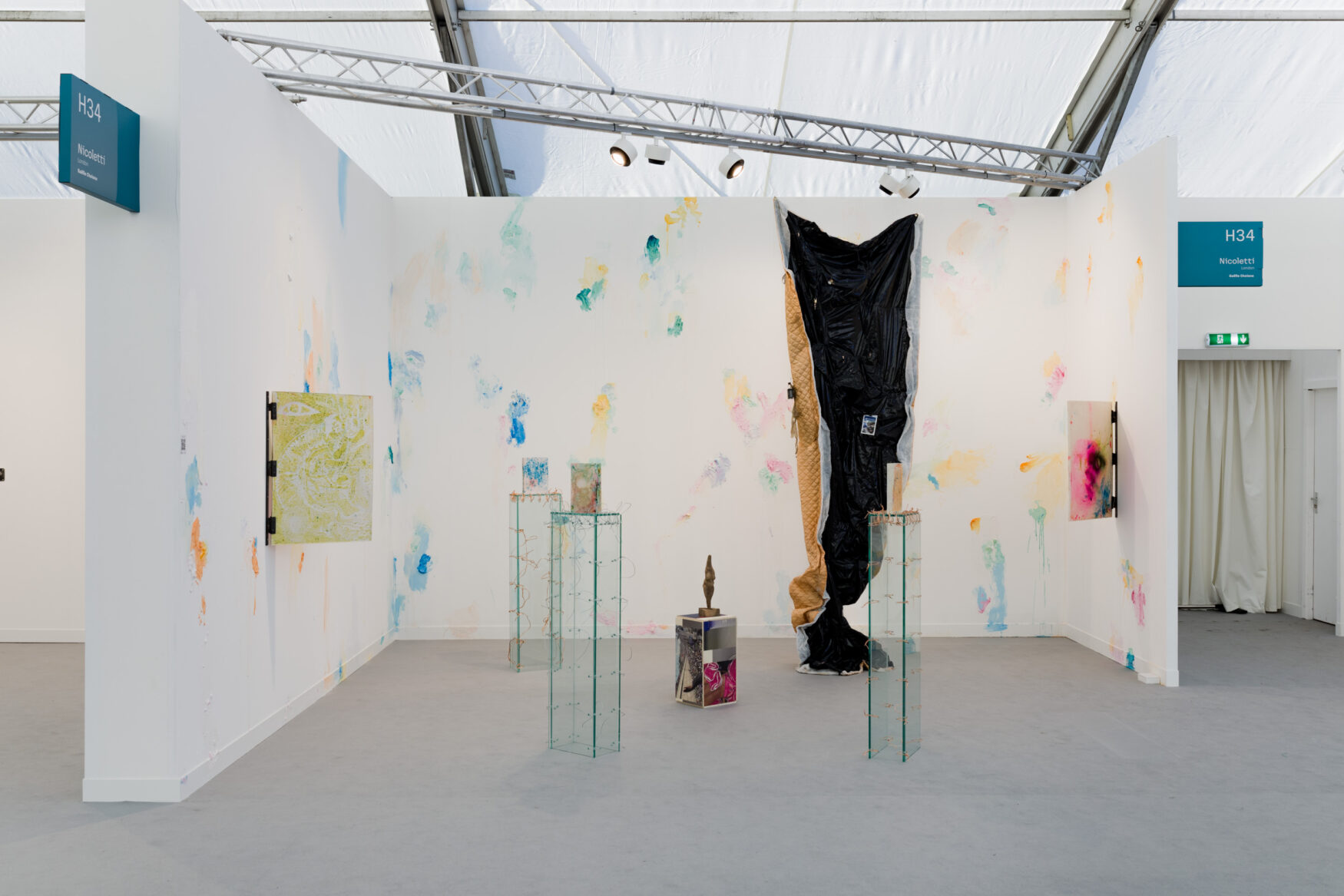
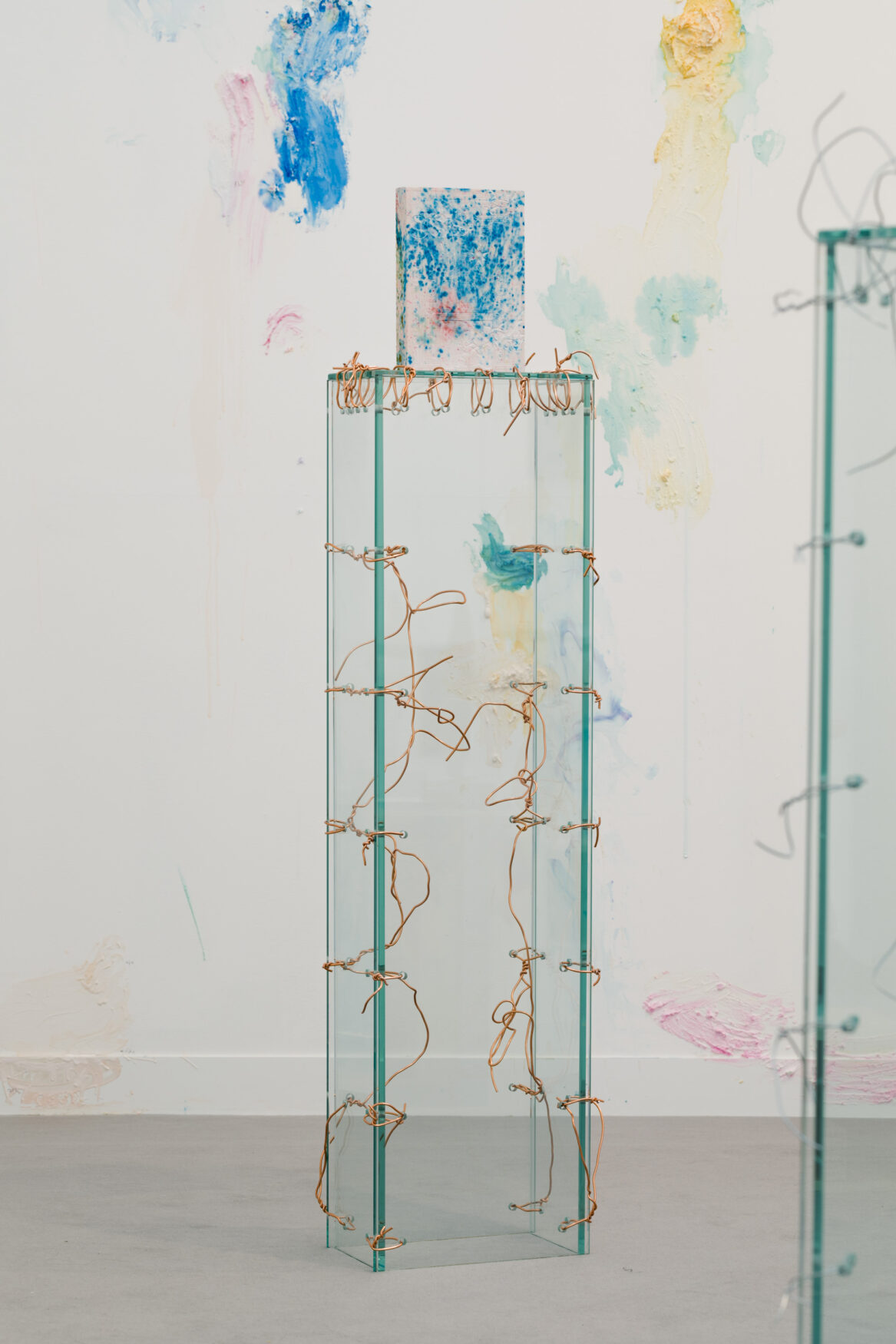
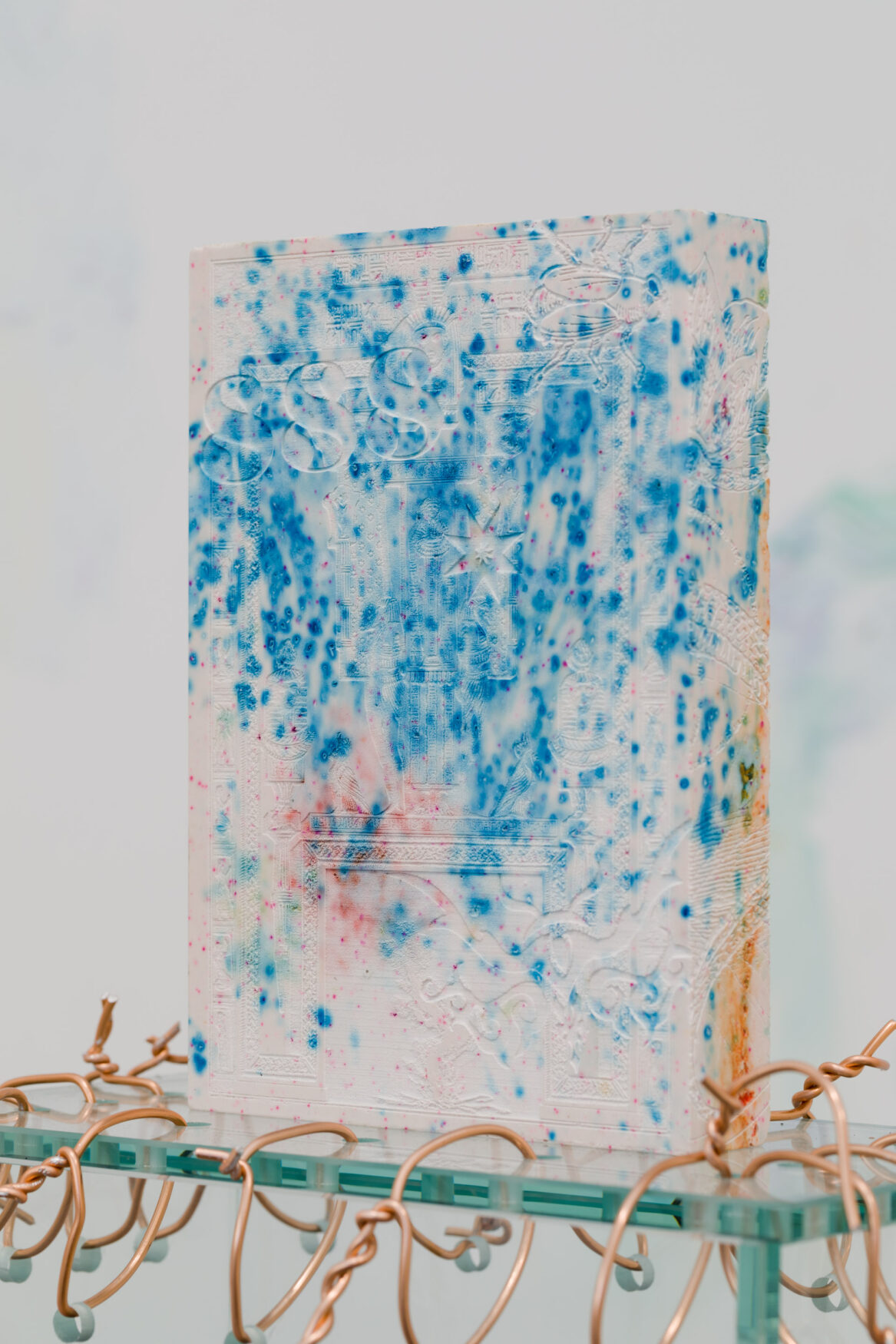
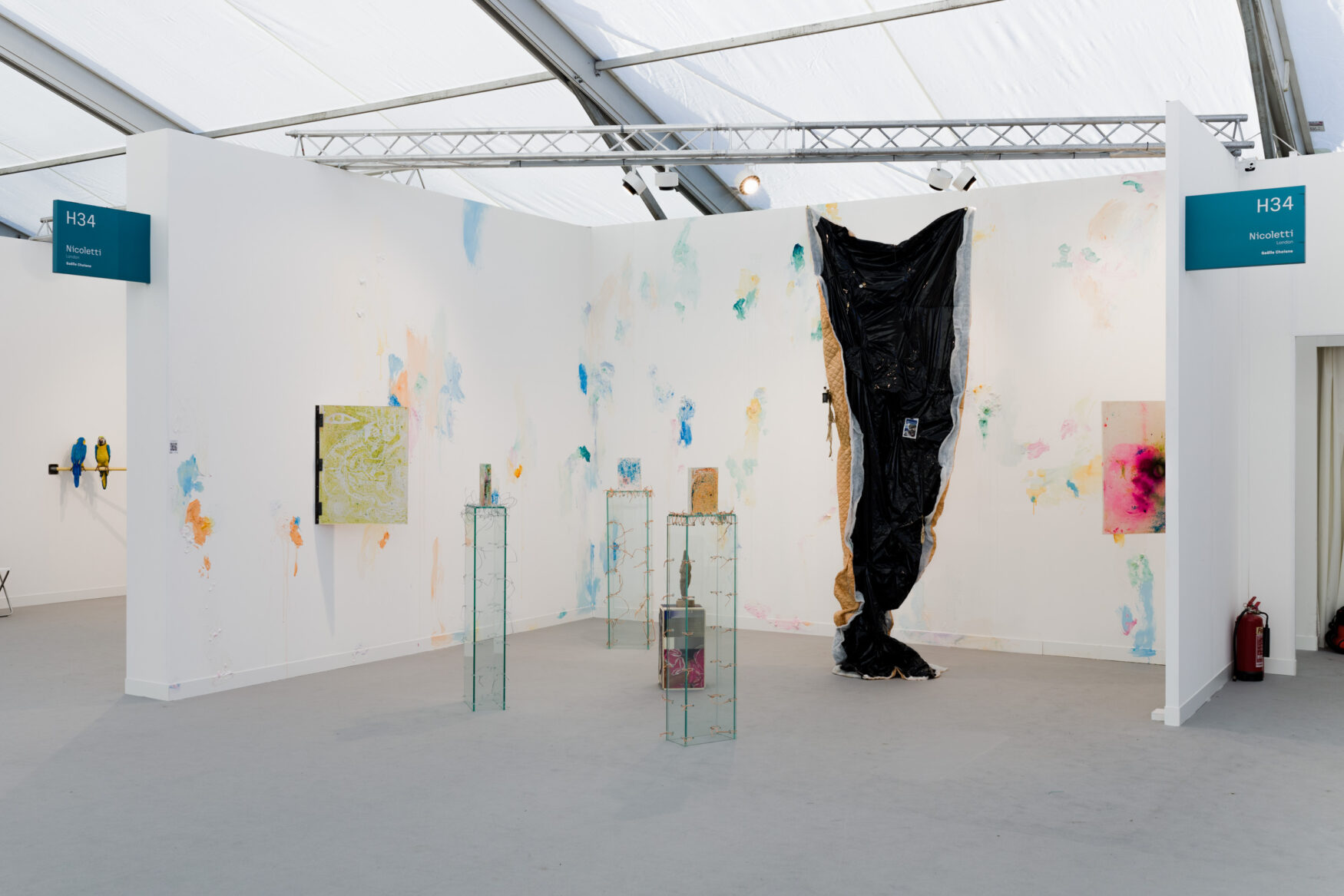
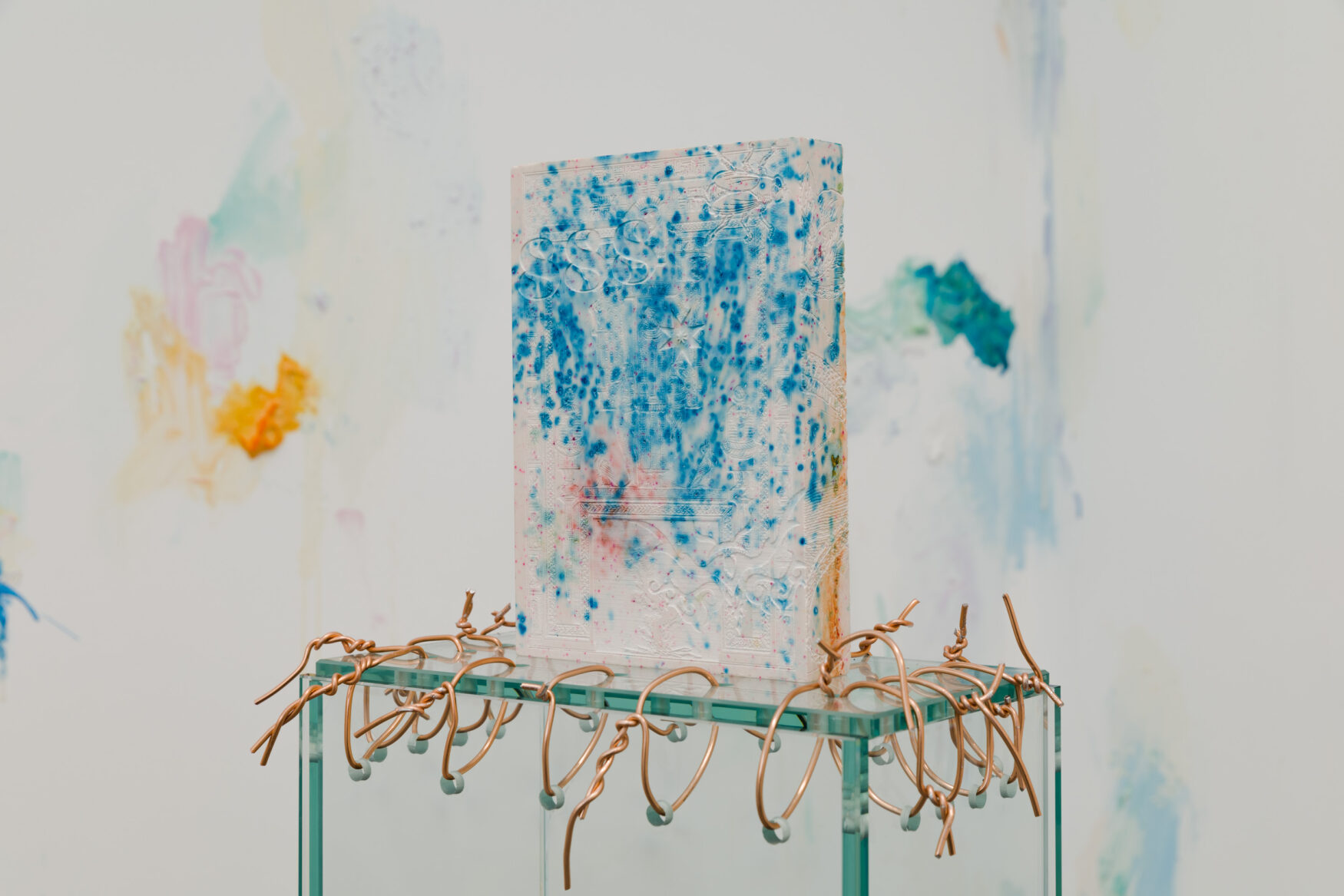
Frieze London, 2022
credits: Jack Elliot Edwards+
NıCOLETTı is delighted to present a solo exhibition by French-Haitian artist Gaelle Choisne (b. 1985). Working with sculpture, photography and objects drawn from Caribbean folk traditions, Choisne creates opulent environments addressing the complex relationship between colonial history, ecology and racism.
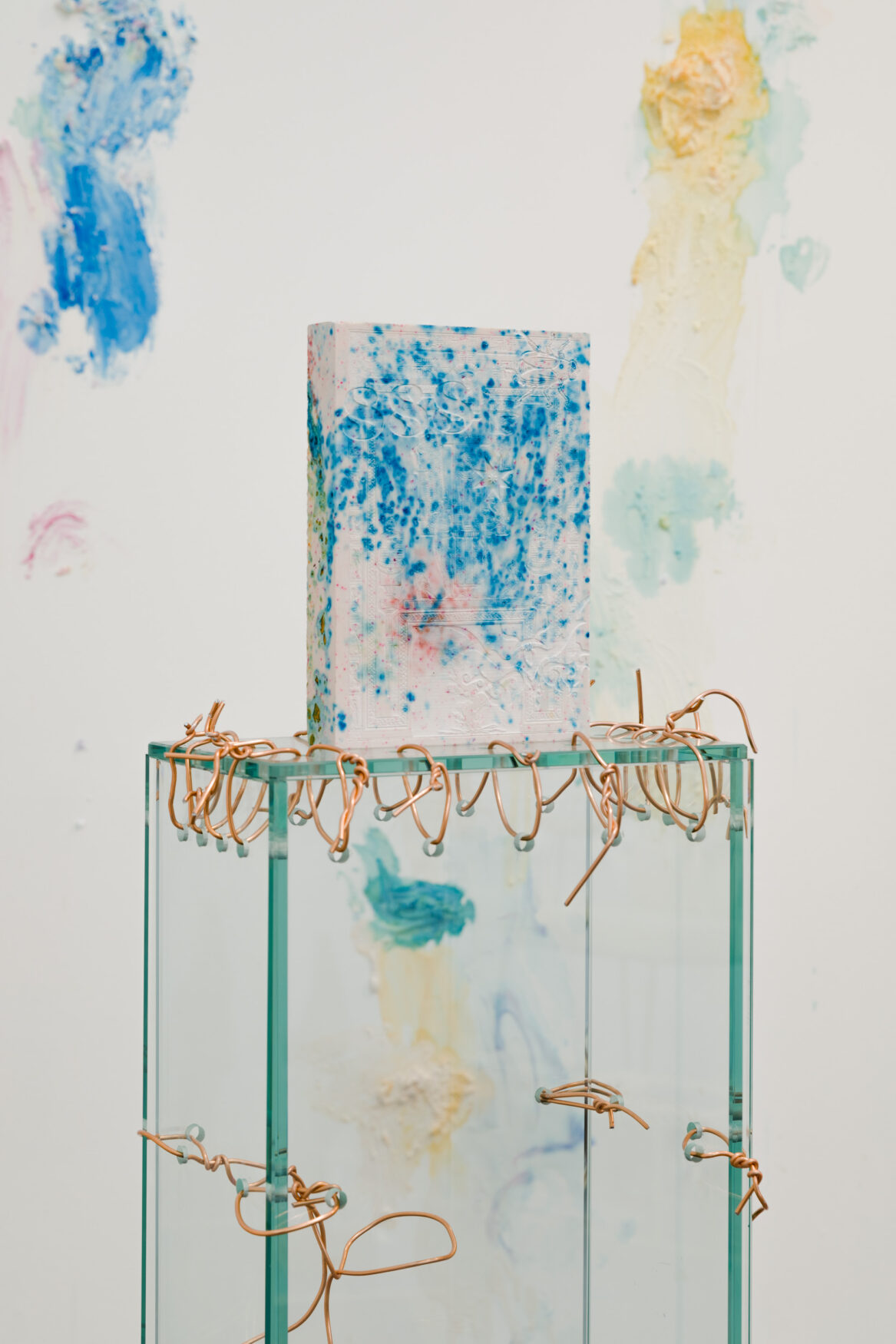
At FRıEZE, Choisne presents five Memoires akashiques [Akashic Records], an ongoing series of sculptures made of acrylic resin and food pigments that the artist first presented at The Fifth New Museum Triennial in 2021. Engraved with figures, plants and medical drawings found in colonial archives, Choisne’s sculptures are named after the Sanskrit term ‘akasha’, which in Hindu philosophy refers to ‘aether’ or ‘atmosphere’. In the 19th century, the term ‘akasha’ was used in the religion of Theosophy to form an esoteric concept designating the ensemble of universal events, thoughts, emotions and intent to have occurred in the past, present, or future, forming a sort of DNA of the universe. Described as the ‘indestructible tablets of the astral light’ by the founder of theosophy H. P. Blavatsky (1831-91), the Akashic Records evoke the inseparability of matter and meaning: that is, how immaterial ideas embed themselves in physical matter and, in turn, how materiality informs the emergence of concepts and thoughts.
Twisting this concept to analyse how the residues of colonialism pervade the material world, Choisne’s sculptures are displayed on glass plinths, contrasting their abounding materiality with lightness and transparency. Two larger versions are mounted on metal binding and shown on the wall, evoking the altarpieces’ panels that alternatively reveal and conceal narratives.
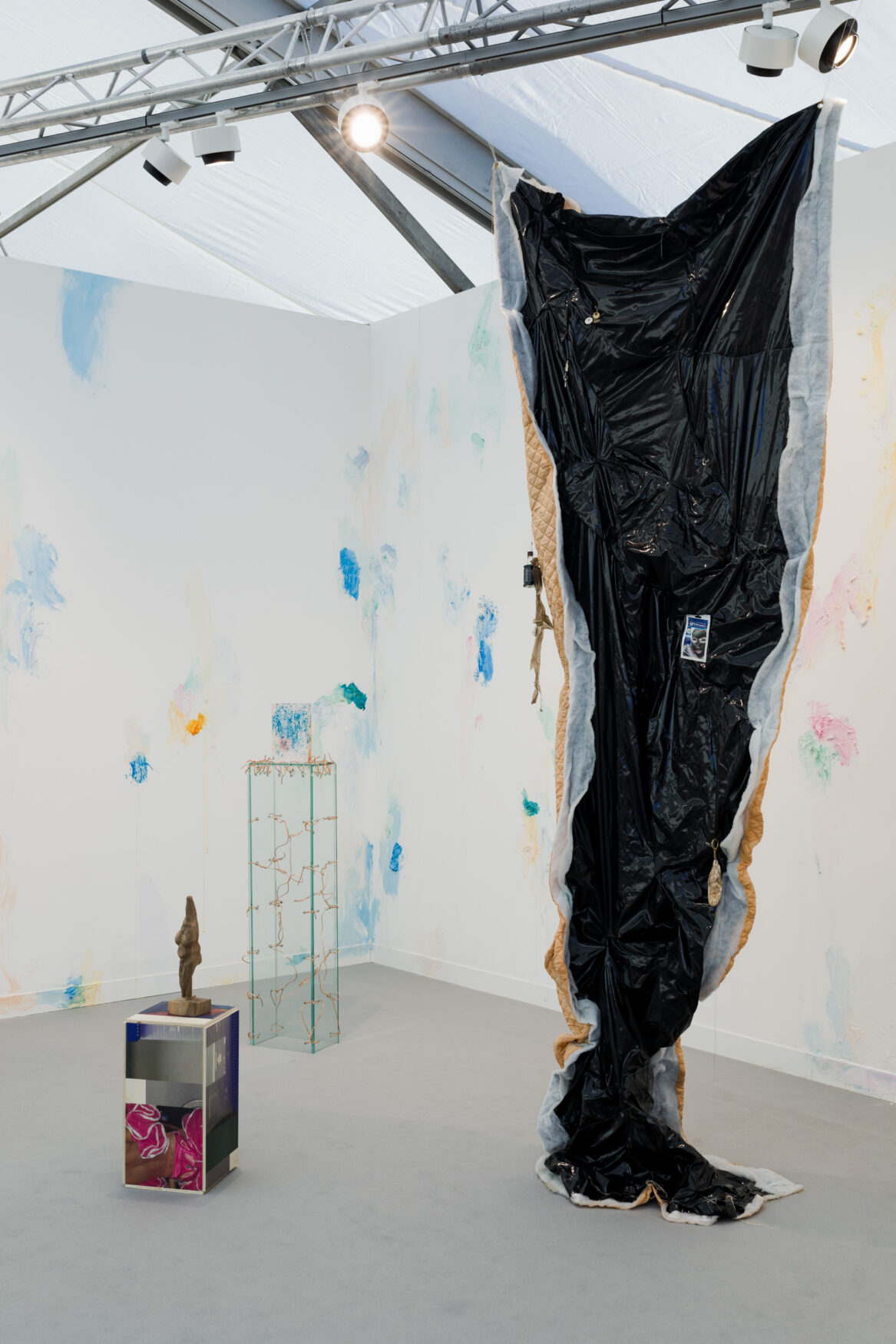
Similar ideas of openness/dissimulation are explored in Some Food for the Afterlife, Blackface (2018), apiece of quilted fabric taking the form of a survival blanket embroidered with objects collected in deserted refugee camps. Conceived as a monument to obliterated lives, Choisne’s textile work is inspired by Cuban artist Carmen Lydia Duric (also know as Hessie, 1936-2017), who created the feminist movement of‘Survival Art’, in which detritus, discarded and everyday objects were used to elaborate tactics of resistance against discrimination, dissolution and loss.
Choisne’s textile work will be accompanied by a Venus carved on walnut. Reminiscent of ancient fertility goddesses, the sculpture was made using a CNC machine, bringing this ancestral icon of women empowerment to the technological present. Presented on a crate printed with photographs taken in Haiti, Choisne’s Venus completes a display reflecting upon the permanent displacement of ideas, memories and beliefs across space and time.


Blue Lights in the Basement, Nicoletti Contemporary, 2022
London, United Kingdom
Courtesy the Artist & Nicoletti Contemporary, London
© David Barreiro
+
Blue Lights in the Basement is the first solo exhibition by French-Haitian artist Gaëlle Choisne in the UK. Describing her work as a ‘kaleidoscopic prism with multiple entries of meanings and signs’, Choisne’s practice revolves around the creation of opulent environments in which the artist interweaves myriad references – from occult fables to objective sciences, through to Caribbean and European literary traditions, queer culture, music and popular imagery –, and media, including sculpture, photography, video, text and sound.
In Blue Lights in the Basement, Choisne presents a series of hybrid assemblages made of a wide range of materials such as wood, textile, ceramic, photographs and moving images, as well as a vast array of found objects, including coins, banknotes, deer antlers and cigarettes. Layering a multitude of narratives, the artworks on display explore the relationships between human beings and their environment – whether it be social, cultural or natural –, analysing the effects that these interactions have on subjectivity. To do so, the artist brings a historical perspective to her own experience, establishing poetic parallels between her personal life, her relationship to sexuality and her skin colour, and the history of Haiti, specifically the Haitian Revolution (22 August 1791–1 January 1804).
Throughout the exhibition, Choisne draws inspiration from the women who played a role in the Revolution and the broader history of Haiti, such as slave and soldier Marie-Jeanne Lamartinière, who served in a male uniform at the Battle of Crête-à-Pierrot (4 March–24 March 1802), or Catherine Flon, who sew the first Haitian flag in 1803. Often muted by historiography, these female voices embody a spirit of bravery and rebellion, affirming the existence of those left out of dominant historical narratives. Through the evocation of these providential figures, the artist questions the way in which processes of invisibilisation operate, drawing our attention to what happens beyond the regimes of the visible and the tangible – in both socio-political and spiritual realms, which Choisne’s transversal gaze tightly interlinks.
Indeed, a logic of crossing, of passage between perceptible and ineffable worlds, spans the exhibition, such as, for instance, in Anathem (2022), a group of three assemblages evoking the form of doors or thresholds. Made of pine wood, ceramic, dyed fabric and printed textile showing, alternatively, a hand (the maker), a magician and a public demonstration (the revolted), the Anathem series evokes the intricate links between practices calling for socio-political justice and rituals aiming to reach a spiritual ‘beyond’.
These connections between history and spirituality, politics and beliefs, also appear in Echo of your EGO (2022), an installation in which cigarettes produced by one of the oldest brands of tobacco (Sobranie, established in London in 1879, smoked by the Imperial House of Russia and the Royal House of Great Britain, owned today by Japan Tobacco), materially encapsulate residues of colonial times. These cigarettes are presented on blocks of ceramic covered by an enamel made of crushed glass taken from hospital needles, recalling the cyclical dance of life and death, as in a vanity.
Similarly, the film Silent Primitive Accumulation (2018–22), which is played on mute to remind us of those who remain voiceless, is presented as part of a series of installations in which the screens are supported by metal, root-like feet, giving the impression of an energetic web sprawling from the underground. Here, the notion of ‘basement’, as suggested by the exhibition title, seems to refer to these unconscious forces that even those who have been disempowered can potentially access.
Indeed, borrowed from an album released by African American singer and activist Roberta Flack in 1977, Blue Lights in the Basement evokes the deep, sensual atmosphere of clubs when slow music is played. It also refers to David Hammons’ Concerto in Black and Blue, presented at Ace Gallery, New York, in 2002, a sensory experience where ‘light failed to provide full visibility, and colour remained helpless in grounding materiality’, bringing a singular prism to questions of race, essence and spirituality.
Similar ideas are explored in Choisne’s exhibition, where the colour blue becomes the symbol of what has been made imperceptible or impalpable, but whose presence continues to haunt reality. Attempting to conjure the effective power and potential of invisible energies, her artworks are not conceived as inert objects, illustrative or evocative of external ideas, but as force fields, composed of both physical and immaterial components. Within this framework, the image of the basement is used to conjure the idea of a hidden space where reproved practices, such as queer cruising, persist in existing; a space where, acting as the glue that holds the building blocks of her assemblages together, love is the ultimate sediment.